Most people who have used a safe deposit box remember the ritual. You arrive, you sign in, a staff member walks you through a heavy door, two keys turn together, and your box comes out of the wall. It works, and it has worked for a century. But almost every part of that process exists because a person has to be there, and that single fact shapes everything else about the service.
How a traditional vault visit works
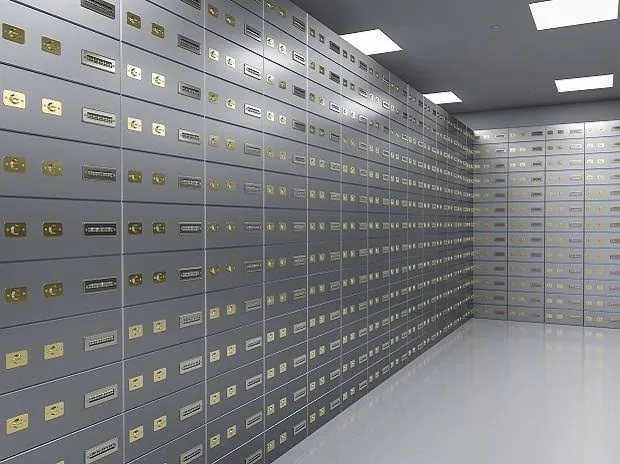
You book or arrive during branch hours. A staff member verifies your identity, retrieves the register, and escorts you into the strongroom. Your box is opened with two keys, yours and theirs, turned together. The staff member either waits nearby or steps out while you use a viewing room, then returns to lock up and sign you out. Every visit consumes staff time from start to finish.
How an automated vault visit works
You book online for a time that suits you. At the entrance you identify yourself using biometric-led access control. Instead of walking into a strongroom, you wait in an enclosed access booth while the automated system locates your box and delivers it to you. You handle the contents alone. When you are finished, the system returns the box to the vault and logs the event. No staff member opens your box, and no staff member needs to be present for the visit to happen.
Who sees what
This is the difference most people notice first. In a traditional vault, at least one other person knows you visited, knows which box is yours, and is standing within a few metres while it is open. Nothing improper needs to happen for that to feel like a lot of exposure for something you chose to store off-site precisely because it is nobody else's business.
In an automated vault, retrieval is a machine operation. The Kavach booths are being built with sensors rather than cameras inside, so what you do with your own box is not recorded visually. Staff are on site to help you, never to handle what is yours.
What happens to waiting
Traditional vault access is bounded by staff availability. If someone else is in the strongroom, you wait. If the branch is short-staffed, you wait. If it is Saturday, in most cases you do not go at all.
Automation moves the constraint from people to throughput. The system can prepare the next box while the current visit is underway, which means access hours are set by when the building is open rather than by who is rostered on. Planned access hours at Marsden Park are Mon–Fri 10am–7pm, Sat–Sun 9am–4pm.
What automation does not change
Worth being clear about the limits. Automation does not make a vault more secure by itself. The physical construction, the monitoring, the alarm and detection systems and the access controls do that work, and they are much the same problem whether a person or a machine fetches the box.
What automation changes is the operating model. Fewer staff hours per visit means a vault does not need city-centre volumes to make sense, which is why automated facilities can sit in suburbs where a staffed one could not. It also removes a category of risk that traditional vaults manage procedurally: if no individual retrieves boxes, no individual needs to be trusted not to.
Where Kavach fits
Kavach is building a suburban vault network using a fully automated vault system. The first vault is planned for Marsden Park in Sydney's north-west, opening Q1 2027, with Melbourne to follow. Registration for priority allocation is open now.